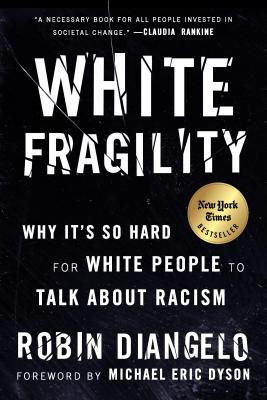
Series One ~ “White Fragility” by Robin DeAngelo
You may purchase “White Fragility” for curbside pickup at Books on the Common at 404 Main St, Ridgefield, by emailing or by calling (203) 431-9100. Read the book summary or purchase online at Books on the Common’s online store.

The Ku Klux Klan (the first iteration) holds its first national meeting in Nashville, Tennessee.
As part of a political compromise that enabled his election, President Rutherford B. Hayes withdraws federal troops from Louisiana—the last federally-occupied former Confederate state—just 12 years after the end of the Civil War. The withdrawal marked the end of Reconstruction and paved the way for the unrestrained resurgence of white supremacist rule in the South, carrying with it the rapid deterioration of political rights for Black people. Congressional efforts to provide federal protection to formerly enslaved Black people were undermined by the U.S. Supreme Court, which overturned laws that provided remedies to Black people facing violent intimidation. In the 1870s, Northern politicians began retreating from a commitment to protect Black rights and lives, culminating in the withdrawal of troops in 1877, the subsequent development and wide implementation of “Jim Crow” rule, and mass terrorizing and deprivation of rights of Black people.
David Harold Blackwell, an American statistician and mathematician who made significant contributions to game theory, probability theory, information theory, and Bayesian statistics, is born to working class parents in Centralia, Illinois. He is one of the eponyms of the Rao–Blackwell theorem. He was the first African American inducted into the National Academy of Sciences, the first black tenured faculty member at the University of California, Berkeley, and the seventh African American to receive a Ph.D. in Mathematics. Blackwell was also a pioneer in textbook writing. He wrote one of the first Bayesian textbooks, his 1969 Basic Statistics. By the time he retired, he had published over 90 books and papers on dynamic programming, game theory, and mathematical statistics.