
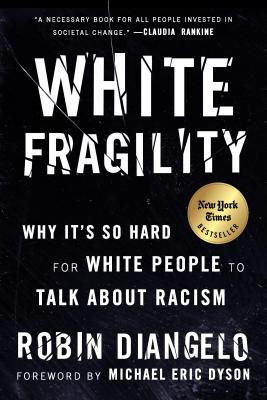
Series One ~ “White Fragility” by Robin DeAngelo
You may purchase “White Fragility” for curbside pickup at Books on the Common at 404 Main St, Ridgefield, by emailing or by calling (203) 431-9100. Read the book summary or purchase online at Books on the Common’s online store.
 The United States Supreme Court issues a landmark ruling on voting rights in Smith v. Allwright, 321 U.S. 649 (1944). The decision overturns the Texas state law that authorized political parties to set their internal rules, including the use of whites-only primaries. The court ruled it was unconstitutional for the state to delegate its authority over elections to parties in order to allow discrimination to be practiced. This ruling affected all other states where the parties used the white primary rule. The Democratic Party had effectively excluded minority voter participation by this means, another device for legal disenfranchisement of Blacks across the South beginning in the late 19th century. Thurgood Marshall, who would later become the first African American justice on the Supreme Court, led the case as executive director of the NAACP Legal Defense and Educational Fund and stated that it was his most important case.
  Malcolm X delivers his “The Ballot or the Bullet” speech in Cleveland, Ohio. In it, he explains his departure from/break with The Nation of Islam and his reason for establishing a separation between his religion and his politics. He also makes clear that those politics are still rooted in black nationalism and that his opposition to the non-violent approach of civil rights leaders such as Martin Luther King is based on his belief that their efforts will delay and possibly deny forever complete black liberation.
 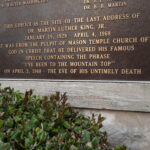 Rev. Dr. Martin Luther King, Jr, delivers his last public address, popularly known as the "I've Been to the Mountaintop" speech, at the Mason Temple (Church of God in Christ Headquarters) in Memphis, Tennessee. The speech primarily concerns the Memphis Sanitation Strike. King calls for unity, economic actions, boycotts, and nonviolent protest, while challenging the United States to live up to its ideals. At the end of the speech, he discusses the possibility of an untimely death. On the following day, King is assassinated.