
This Day in History: 1914-08-14
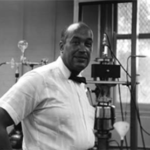 Biophysics pioneer, education advocate, and activist Dr. Herman Branson is born in Pocahontas, Virginia. After a primary and elementary education, Branson attended Virginia College (now Virginia State University). After receiving a Bachelor of Science degree in 1936, Branson enrolled in the University of Cincinnati where he studied physics. In 1939, he received a Ph.D. and started a career in academia. From 1942 to 1943 he served as Assistant Professor of Physics and Chemistry at Howard University. Simultaneously, Branson also served as the Director of the Experimental Science and Mathematics Technology (ESMWT) Program in Physics. In 1944, Dr. Branson became a tenured professor of Physics and was named Chairman of the Physics Department of Howard University. He would serve, nearly uninterrupted, in this capacity from 1941 to 1968. In 1948, Branson entered into partnership with Linus Pauling at the California Institute of Technology, focusing on the structure of proteins. Branson pioneered the use of mathematics to determine possible helical structures that would fit the x-ray data, as well as chemical restrictions that had been outlined by Pauling. Branson narrowed the possible structures of two helices. The two coils were named Alpha and Gamma. Pauling initially dismissed Branson’s work, saying that the shape of Branson’s coil was impossible. Later, however, Pauling published the data in his own name, giving Herman Branson minor credit for his original research. In the initial press release from Caltech University, announcing the discovery of the Alpha Helix, Herman Branson’s name is excluded. When Linus Pauling received a Nobel Prize for his contribution to Chemistry in 1954, Branson was not credited for his contribution. After working with Pauling, Branson returned to his position at Howard University as a full professor of Physics and Chairman of the Physics Department. He stayed at Howard University for 27 years, teaching and directing. In 1968, he served briefly as the President of Central State University in Ohio. In 1970, Branson assumed the position of President at Lincoln University of Pennsylvania where he served until his retirement in 1985. Dr. Branson published more than one hundred articles in his lifetime on topics including physics, biology, science education, and the importance of Historically Black Colleges and Universities (HBCUs). Learn more.